
Ditching the Laptop: Why Electronic Artists Are Turning to Modular Rigs on Stage

The Glow of the Screen Is Losing Its Charm

For years, the laptop has been electronic music”s ultimate backstage utility player. It stores the tracks, hosts the instruments, manages effects, handles synchronization, and can reproduce a highly polished arrangement with astonishing consistency. Yet that efficiency has created a cultural problem. In many clubs, audiences have grown weary of watching performers stand behind a glowing rectangle while the most important musical decisions remain hidden inside software.

The demand now is not simply for older equipment or a more photogenic stage. Promoters and listeners are searching for visible effort, physical movement, and the possibility that something genuinely different might happen from one performance to the next. Eurorack systems, drum machines, sequencers, and compact analog instruments answer that demand with cables, knobs, voltage, timing instability, and obvious human intervention. The resurgence of modular performance reflects a broader desire to make electronic music feel present again, not merely played back.

The Psychology of Risk and Audience Tension

Pressing the spacebar and manipulating a live control-voltage network may both trigger sound, but they communicate very different psychological signals. A laptop performance can be musically complex while remaining visually opaque. The audience often cannot tell whether a performer is launching a carefully prepared scene, adjusting an effect, monitoring a technical issue, or simply waiting for the next transition. A modular rig reverses that relationship. Every patch cable, fader, and envelope becomes evidence of an active decision.

That visibility changes the emotional temperature of a room. A filter can close too quickly, a sequence can fall out of alignment, and a resonant feedback loop can become more aggressive than expected. These are not automatically failures. They are risk states, and risk creates attention. When listeners sense that the performer must respond in real time, a sustained note or unstable rhythm can carry more tension than an identical sound reproduced perfectly from a session file.

The physicality also gives audiences a readable performance language. Hands move toward a mixer, cables are repatched, a pattern is muted, and a performer leans closer to hear whether a texture is becoming useful or dangerous. This visual kinesthetics links the body on stage to the sound in the room. The history of modular instruments, from early voltage-controlled experimentation to contemporary Eurorack systems, is mapped in detail by this history of modular synthesis.
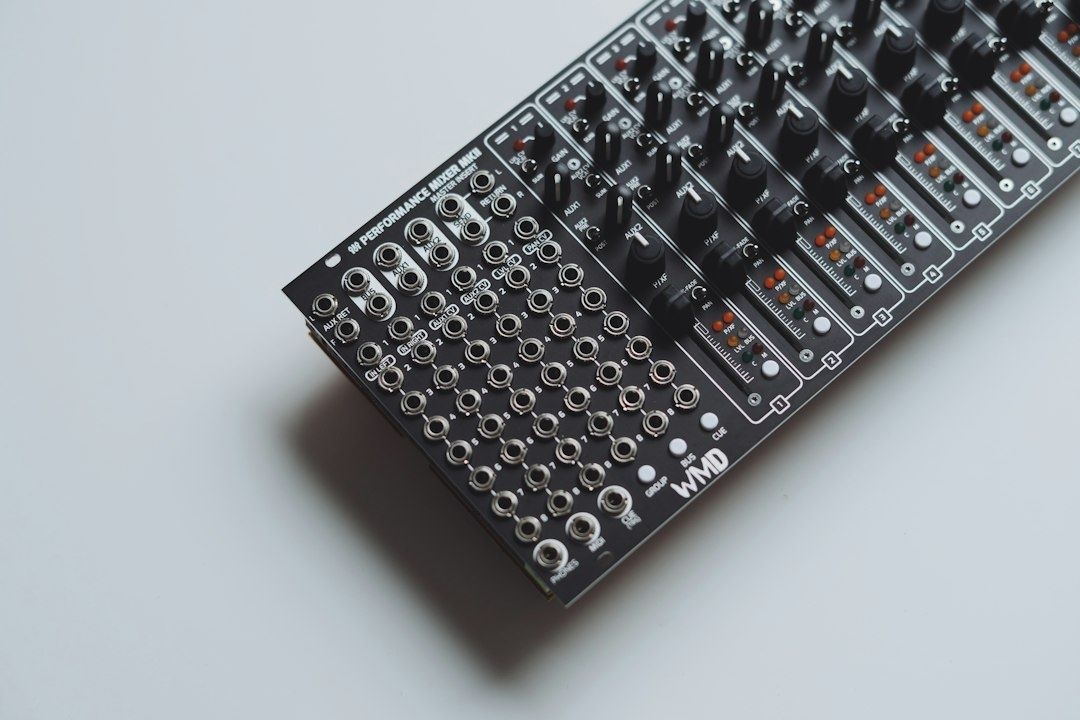
Close-up of a black audio mixer with knobs, jacks, and level meters
Hands-on control makes the performer”s choices visible, turning each transition, adjustment, and moment of instability into part of the live musical narrative.
  • Risk creates focus: an uncertain transition gives the room a reason to listen closely.
  • Movement creates legibility: audiences can see which gestures are shaping the music.
  • Imperfection creates memory: an unusual distortion or unexpected rhythmic turn can become the defining moment of a set.

That does not mean every mistake produces magic. Poor gain staging, dead cables, or an unplanned loss of synchronization can end momentum quickly. The point is that a hardware performance exposes consequences, and consequences produce audience investment. A clubgoer may not understand the technical path from oscillator to sequencer, but can still recognize when a performer is steering a volatile machine rather than simply revealing a finished result.

Studio Perfection Versus Stage Volatility

A digital audio workstation is built around repeatability. Arrangements can be recalled, edits can be corrected, plugins can be automated, and a complete performance can be rehearsed until every transition lands exactly where intended. Eurorack works from a different set of conditions. Patch points, component tolerances, timing fluctuations, and hands-on control encourage variation. Even when a performer rebuilds the same patch, the result may differ because the instrument is being played through changing gestures and changing relationships between modules.

The choice is therefore less about whether one system is technologically superior. It is about what kind of attention the performance wants to generate. A laptop can offer extraordinary depth, while modular hardware can impose productive limits. The following comparison shows why artists increasingly combine or replace screen-based setups.

Performance factor DAW-based setup Modular or hardware-centered setup
Ergonomics Compact, highly configurable, but dependent on a screen, mouse, and menus Immediate physical access, though dense panels can become difficult in low light
Reliability Consistent when the computer, software, drivers, and interfaces cooperate Fewer software dependencies, but cables, power supplies, and individual modules can fail
Sonic distinctiveness Extremely broad, although popular plugins and presets can encourage familiarity Strongly shaped by the performer”s patching choices, modules, and signal path
Improvisation potential High when mapped carefully, but often organized around prepared scenes and clips High through live routing, modulation, sequencing, and manual intervention

Removing the screen also changes the performer”s training. Muscle memory replaces menu navigation, while ear training becomes essential because visual confirmation is limited. A performer learns the physical distance between controls, the feel of a knob at a particular setting, and the audible consequences of opening one route while closing another. This can make the set more vulnerable, but it can also make the musician more responsive to the room.

Forging a Signature Sonic Identity in an Era of Presets

The modern producer has access to an extraordinary library of sounds, yet abundance can produce sameness. The same software synthesizers, drum libraries, mixing chains, and preset packs appear across countless productions. This does not make digital music inherently generic, but it raises the importance of curation and transformation. When a familiar plugin becomes the starting point for thousands of tracks, the artist must work harder to make the resulting sound unmistakably theirs.

A custom modular system offers a different route to identity. The instrument is assembled around personal priorities, whether those involve unstable oscillators, unusual sequencing, dense feedback, generative rhythm, or highly controlled percussion. Another producer might own some of the same modules, but is unlikely to reproduce the exact combination of firmware, patch cables, calibration, performance habits, and studio decisions. The instrument becomes more than a collection of products. It becomes a physical vocabulary.

This approach continues a long development in electronic music, where instruments have repeatedly expanded the performer”s physical role. From early electronic experiments to synthesizers, samplers, sequencers, and modern modular systems, the instrument has shaped how sound is touched, triggered, interrupted, and staged. A broader account of that evolution appears in this overview of electronic instruments, which helps place current hardware culture within a much longer history of technological performance.

  • Design around a musical problem: choose modules that solve a rhythmic, melodic, textural, or performative need rather than simply adding prestige.
  • Keep one or two signature pathways: a recognizable feedback route, modulation pattern, or sequencing method can become part of an artist”s sonic brand.
  • Build for the stage: controls that are spectacular in the studio may be useless if they are too small, too close together, or impossible to reach during a transition.
  • Document the exceptions: unusual accidents can become repeatable techniques without turning the entire performance into a fixed script.

Custom signal paths also create instantly identifiable club moments. A kick may begin as a clean pulse, then acquire a metallic edge through external processing. A melody may dissolve into a cloud of delayed fragments before returning as a new rhythm. Because the transformation is performed rather than merely recalled, the audience hears the artist”s decisions as part of the composition. That connection can strengthen fan engagement in the same way a distinctive visual identity or recognizable release strategy strengthens an artist”s wider positioning.

Navigating the Logistical Realities of Touring with Hardware

The romance of a modular rig meets practical resistance as soon as a performer leaves the studio. Air travel brings limits on size, weight, batteries, and checked equipment. Venues vary in power stability and stage layout. A case that feels manageable in a rehearsal room can become a serious burden after repeated transfers between airports, hotels, loading docks, and club booths. Hardware is also exposed to physical damage, loose connections, missing power supplies, and the simple fatigue that accumulates across a tour.

Road-ready design begins with ruthless prioritization. The strongest touring rigs are rarely the largest ones. They are systems in which each module has a clear performance role, critical controls are reachable, and backup plans exist for the functions that cannot fail. Some artists use a compact modular voice supported by a sampler or drum machine. Others keep a small hardware core while retaining a laptop as an emergency layer. The goal is not ideological purity. The goal is to preserve the sensation of active performance under real touring conditions.

  1. Define the non-negotiable functions: identify the clock, rhythm, bass, melodic, sampling, and effects duties that must survive every show.
  2. Build a compact signal path: remove modules that are impressive in isolation but rarely affect the live arrangement.
  3. Protect the system: use a robust case, secure cables, label critical connections, and carry essential adapters and spares.
  4. Rehearse failure recovery: practice bypassing a dead voice, restarting synchronization, and continuing after an unexpected patch change.
  5. Measure setup time: a rig that cannot be assembled calmly before soundcheck is not yet a touring instrument.

This is where the bedroom gear hobbyist either develops into a road-tested performer or discovers that collecting equipment is not the same as operating an instrument. Touring rewards repeatable preparation, disciplined packing, and musical restraint. It also rewards knowing when to leave space. A compact system with a few high-impact gestures can create more audience pull than an overloaded case that forces the performer to manage equipment instead of shaping the set.

Reclaiming the Element of Surprise on the Dance Floor

Modular synthesis on stage is not simply gear fetishism. At its best, it is a cultural response to a performance environment that has become too easy to predict. The appeal lies in visible authorship, audible risk, and the possibility that a track will not behave exactly as it did yesterday. For artists, that can create a stronger connection between sound, body, and stage identity. For audiences, it restores the feeling that attending a live set means witnessing an event rather than receiving a flawless presentation.

Stripping the laptop from a rig is still a serious decision. Artists must weigh portability, reliability, preparation time, repair risk, and the musical demands of the material. A hybrid setup may deliver the strongest balance, combining hardware”s tactile immediacy with software”s flexibility and safety net. The larger movement is not a rejection of technology. It is a redefinition of what technology should make visible. To play electronic music live now means giving the audience a reason to believe that the performance is happening in the room, under pressure, with consequences.


Ditching the Laptop: Why Electronic Artists Are Turning to Modular Rigs on Stage

The Glow of the Screen Is Losing Its Charm

For years, the laptop has been electronic music”s ultimate backstage utility player. It stores the tracks, hosts the instruments, manages effects, handles synchronization, and can reproduce a highly polished arrangement with astonishing consistency. Yet that efficiency has created a cultural problem. In many clubs, audiences have grown weary of watching performers stand behind a glowing rectangle while the most important musical decisions remain hidden inside software.

The demand now is not simply for older equipment or a more photogenic stage. Promoters and listeners are searching for visible effort, physical movement, and the possibility that something genuinely different might happen from one performance to the next. Eurorack systems, drum machines, sequencers, and compact analog instruments answer that demand with cables, knobs, voltage, timing instability, and obvious human intervention. The resurgence of modular performance reflects a broader desire to make electronic music feel present again, not merely played back.

The Psychology of Risk and Audience Tension

Pressing the spacebar and manipulating a live control-voltage network may both trigger sound, but they communicate very different psychological signals. A laptop performance can be musically complex while remaining visually opaque. The audience often cannot tell whether a performer is launching a carefully prepared scene, adjusting an effect, monitoring a technical issue, or simply waiting for the next transition. A modular rig reverses that relationship. Every patch cable, fader, and envelope becomes evidence of an active decision.

That visibility changes the emotional temperature of a room. A filter can close too quickly, a sequence can fall out of alignment, and a resonant feedback loop can become more aggressive than expected. These are not automatically failures. They are risk states, and risk creates attention. When listeners sense that the performer must respond in real time, a sustained note or unstable rhythm can carry more tension than an identical sound reproduced perfectly from a session file.

The physicality also gives audiences a readable performance language. Hands move toward a mixer, cables are repatched, a pattern is muted, and a performer leans closer to hear whether a texture is becoming useful or dangerous. This visual kinesthetics links the body on stage to the sound in the room. The history of modular instruments, from early voltage-controlled experimentation to contemporary Eurorack systems, is mapped in detail by this history of modular synthesis.

Close-up of a black audio mixer with knobs, jacks, and level meters
Hands-on control makes the performer”s choices visible, turning each transition, adjustment, and moment of instability into part of the live musical narrative.
  • Risk creates focus: an uncertain transition gives the room a reason to listen closely.
  • Movement creates legibility: audiences can see which gestures are shaping the music.
  • Imperfection creates memory: an unusual distortion or unexpected rhythmic turn can become the defining moment of a set.

That does not mean every mistake produces magic. Poor gain staging, dead cables, or an unplanned loss of synchronization can end momentum quickly. The point is that a hardware performance exposes consequences, and consequences produce audience investment. A clubgoer may not understand the technical path from oscillator to sequencer, but can still recognize when a performer is steering a volatile machine rather than simply revealing a finished result.

Studio Perfection Versus Stage Volatility

A digital audio workstation is built around repeatability. Arrangements can be recalled, edits can be corrected, plugins can be automated, and a complete performance can be rehearsed until every transition lands exactly where intended. Eurorack works from a different set of conditions. Patch points, component tolerances, timing fluctuations, and hands-on control encourage variation. Even when a performer rebuilds the same patch, the result may differ because the instrument is being played through changing gestures and changing relationships between modules.

The choice is therefore less about whether one system is technologically superior. It is about what kind of attention the performance wants to generate. A laptop can offer extraordinary depth, while modular hardware can impose productive limits. The following comparison shows why artists increasingly combine or replace screen-based setups.

Performance factor DAW-based setup Modular or hardware-centered setup
Ergonomics Compact, highly configurable, but dependent on a screen, mouse, and menus Immediate physical access, though dense panels can become difficult in low light
Reliability Consistent when the computer, software, drivers, and interfaces cooperate Fewer software dependencies, but cables, power supplies, and individual modules can fail
Sonic distinctiveness Extremely broad, although popular plugins and presets can encourage familiarity Strongly shaped by the performer”s patching choices, modules, and signal path
Improvisation potential High when mapped carefully, but often organized around prepared scenes and clips High through live routing, modulation, sequencing, and manual intervention

Removing the screen also changes the performer”s training. Muscle memory replaces menu navigation, while ear training becomes essential because visual confirmation is limited. A performer learns the physical distance between controls, the feel of a knob at a particular setting, and the audible consequences of opening one route while closing another. This can make the set more vulnerable, but it can also make the musician more responsive to the room.

Forging a Signature Sonic Identity in an Era of Presets

The modern producer has access to an extraordinary library of sounds, yet abundance can produce sameness. The same software synthesizers, drum libraries, mixing chains, and preset packs appear across countless productions. This does not make digital music inherently generic, but it raises the importance of curation and transformation. When a familiar plugin becomes the starting point for thousands of tracks, the artist must work harder to make the resulting sound unmistakably theirs.

A custom modular system offers a different route to identity. The instrument is assembled around personal priorities, whether those involve unstable oscillators, unusual sequencing, dense feedback, generative rhythm, or highly controlled percussion. Another producer might own some of the same modules, but is unlikely to reproduce the exact combination of firmware, patch cables, calibration, performance habits, and studio decisions. The instrument becomes more than a collection of products. It becomes a physical vocabulary.

This approach continues a long development in electronic music, where instruments have repeatedly expanded the performer”s physical role. From early electronic experiments to synthesizers, samplers, sequencers, and modern modular systems, the instrument has shaped how sound is touched, triggered, interrupted, and staged. A broader account of that evolution appears in this overview of electronic instruments, which helps place current hardware culture within a much longer history of technological performance.

  • Design around a musical problem: choose modules that solve a rhythmic, melodic, textural, or performative need rather than simply adding prestige.
  • Keep one or two signature pathways: a recognizable feedback route, modulation pattern, or sequencing method can become part of an artist”s sonic brand.
  • Build for the stage: controls that are spectacular in the studio may be useless if they are too small, too close together, or impossible to reach during a transition.
  • Document the exceptions: unusual accidents can become repeatable techniques without turning the entire performance into a fixed script.

Custom signal paths also create instantly identifiable club moments. A kick may begin as a clean pulse, then acquire a metallic edge through external processing. A melody may dissolve into a cloud of delayed fragments before returning as a new rhythm. Because the transformation is performed rather than merely recalled, the audience hears the artist”s decisions as part of the composition. That connection can strengthen fan engagement in the same way a distinctive visual identity or recognizable release strategy strengthens an artist”s wider positioning.

Navigating the Logistical Realities of Touring with Hardware

The romance of a modular rig meets practical resistance as soon as a performer leaves the studio. Air travel brings limits on size, weight, batteries, and checked equipment. Venues vary in power stability and stage layout. A case that feels manageable in a rehearsal room can become a serious burden after repeated transfers between airports, hotels, loading docks, and club booths. Hardware is also exposed to physical damage, loose connections, missing power supplies, and the simple fatigue that accumulates across a tour.

Road-ready design begins with ruthless prioritization. The strongest touring rigs are rarely the largest ones. They are systems in which each module has a clear performance role, critical controls are reachable, and backup plans exist for the functions that cannot fail. Some artists use a compact modular voice supported by a sampler or drum machine. Others keep a small hardware core while retaining a laptop as an emergency layer. The goal is not ideological purity. The goal is to preserve the sensation of active performance under real touring conditions.

  1. Define the non-negotiable functions: identify the clock, rhythm, bass, melodic, sampling, and effects duties that must survive every show.
  2. Build a compact signal path: remove modules that are impressive in isolation but rarely affect the live arrangement.
  3. Protect the system: use a robust case, secure cables, label critical connections, and carry essential adapters and spares.
  4. Rehearse failure recovery: practice bypassing a dead voice, restarting synchronization, and continuing after an unexpected patch change.
  5. Measure setup time: a rig that cannot be assembled calmly before soundcheck is not yet a touring instrument.

This is where the bedroom gear hobbyist either develops into a road-tested performer or discovers that collecting equipment is not the same as operating an instrument. Touring rewards repeatable preparation, disciplined packing, and musical restraint. It also rewards knowing when to leave space. A compact system with a few high-impact gestures can create more audience pull than an overloaded case that forces the performer to manage equipment instead of shaping the set.

Reclaiming the Element of Surprise on the Dance Floor

Modular synthesis on stage is not simply gear fetishism. At its best, it is a cultural response to a performance environment that has become too easy to predict. The appeal lies in visible authorship, audible risk, and the possibility that a track will not behave exactly as it did yesterday. For artists, that can create a stronger connection between sound, body, and stage identity. For audiences, it restores the feeling that attending a live set means witnessing an event rather than receiving a flawless presentation.

Stripping the laptop from a rig is still a serious decision. Artists must weigh portability, reliability, preparation time, repair risk, and the musical demands of the material. A hybrid setup may deliver the strongest balance, combining hardware”s tactile immediacy with software”s flexibility and safety net. The larger movement is not a rejection of technology. It is a redefinition of what technology should make visible. To play electronic music live now means giving the audience a reason to believe that the performance is happening in the room, under pressure, with consequences.

Ditching the Laptop: Why Electronic Artists Are Turning to Modular Rigs on Stage

The Glow of the Screen Is Losing Its Charm

For years, the laptop has been electronic music”s ultimate backstage utility player. It stores the tracks, hosts the instruments, manages effects, handles synchronization, and can reproduce a highly polished arrangement with astonishing consistency. Yet that efficiency has created a cultural problem. In many clubs, audiences have grown weary of watching performers stand behind a glowing rectangle while the most important musical decisions remain hidden inside software.

The demand now is not simply for older equipment or a more photogenic stage. Promoters and listeners are searching for visible effort, physical movement, and the possibility that something genuinely different might happen from one performance to the next. Eurorack systems, drum machines, sequencers, and compact analog instruments answer that demand with cables, knobs, voltage, timing instability, and obvious human intervention. The resurgence of modular performance reflects a broader desire to make electronic music feel present again, not merely played back.

The Psychology of Risk and Audience Tension

Pressing the spacebar and manipulating a live control-voltage network may both trigger sound, but they communicate very different psychological signals. A laptop performance can be musically complex while remaining visually opaque. The audience often cannot tell whether a performer is launching a carefully prepared scene, adjusting an effect, monitoring a technical issue, or simply waiting for the next transition. A modular rig reverses that relationship. Every patch cable, fader, and envelope becomes evidence of an active decision.

That visibility changes the emotional temperature of a room. A filter can close too quickly, a sequence can fall out of alignment, and a resonant feedback loop can become more aggressive than expected. These are not automatically failures. They are risk states, and risk creates attention. When listeners sense that the performer must respond in real time, a sustained note or unstable rhythm can carry more tension than an identical sound reproduced perfectly from a session file.

The physicality also gives audiences a readable performance language. Hands move toward a mixer, cables are repatched, a pattern is muted, and a performer leans closer to hear whether a texture is becoming useful or dangerous. This visual kinesthetics links the body on stage to the sound in the room. The history of modular instruments, from early voltage-controlled experimentation to contemporary Eurorack systems, is mapped in detail by this history of modular synthesis.

Close-up of a black audio mixer with knobs, jacks, and level meters
Hands-on control makes the performer”s choices visible, turning each transition, adjustment, and moment of instability into part of the live musical narrative.
  • Risk creates focus: an uncertain transition gives the room a reason to listen closely.
  • Movement creates legibility: audiences can see which gestures are shaping the music.
  • Imperfection creates memory: an unusual distortion or unexpected rhythmic turn can become the defining moment of a set.

That does not mean every mistake produces magic. Poor gain staging, dead cables, or an unplanned loss of synchronization can end momentum quickly. The point is that a hardware performance exposes consequences, and consequences produce audience investment. A clubgoer may not understand the technical path from oscillator to sequencer, but can still recognize when a performer is steering a volatile machine rather than simply revealing a finished result.

Studio Perfection Versus Stage Volatility

A digital audio workstation is built around repeatability. Arrangements can be recalled, edits can be corrected, plugins can be automated, and a complete performance can be rehearsed until every transition lands exactly where intended. Eurorack works from a different set of conditions. Patch points, component tolerances, timing fluctuations, and hands-on control encourage variation. Even when a performer rebuilds the same patch, the result may differ because the instrument is being played through changing gestures and changing relationships between modules.

The choice is therefore less about whether one system is technologically superior. It is about what kind of attention the performance wants to generate. A laptop can offer extraordinary depth, while modular hardware can impose productive limits. The following comparison shows why artists increasingly combine or replace screen-based setups.

Performance factor DAW-based setup Modular or hardware-centered setup
Ergonomics Compact, highly configurable, but dependent on a screen, mouse, and menus Immediate physical access, though dense panels can become difficult in low light
Reliability Consistent when the computer, software, drivers, and interfaces cooperate Fewer software dependencies, but cables, power supplies, and individual modules can fail
Sonic distinctiveness Extremely broad, although popular plugins and presets can encourage familiarity Strongly shaped by the performer”s patching choices, modules, and signal path
Improvisation potential High when mapped carefully, but often organized around prepared scenes and clips High through live routing, modulation, sequencing, and manual intervention

Removing the screen also changes the performer”s training. Muscle memory replaces menu navigation, while ear training becomes essential because visual confirmation is limited. A performer learns the physical distance between controls, the feel of a knob at a particular setting, and the audible consequences of opening one route while closing another. This can make the set more vulnerable, but it can also make the musician more responsive to the room.

Forging a Signature Sonic Identity in an Era of Presets

The modern producer has access to an extraordinary library of sounds, yet abundance can produce sameness. The same software synthesizers, drum libraries, mixing chains, and preset packs appear across countless productions. This does not make digital music inherently generic, but it raises the importance of curation and transformation. When a familiar plugin becomes the starting point for thousands of tracks, the artist must work harder to make the resulting sound unmistakably theirs.

A custom modular system offers a different route to identity. The instrument is assembled around personal priorities, whether those involve unstable oscillators, unusual sequencing, dense feedback, generative rhythm, or highly controlled percussion. Another producer might own some of the same modules, but is unlikely to reproduce the exact combination of firmware, patch cables, calibration, performance habits, and studio decisions. The instrument becomes more than a collection of products. It becomes a physical vocabulary.

This approach continues a long development in electronic music, where instruments have repeatedly expanded the performer”s physical role. From early electronic experiments to synthesizers, samplers, sequencers, and modern modular systems, the instrument has shaped how sound is touched, triggered, interrupted, and staged. A broader account of that evolution appears in this overview of electronic instruments, which helps place current hardware culture within a much longer history of technological performance.

  • Design around a musical problem: choose modules that solve a rhythmic, melodic, textural, or performative need rather than simply adding prestige.
  • Keep one or two signature pathways: a recognizable feedback route, modulation pattern, or sequencing method can become part of an artist”s sonic brand.
  • Build for the stage: controls that are spectacular in the studio may be useless if they are too small, too close together, or impossible to reach during a transition.
  • Document the exceptions: unusual accidents can become repeatable techniques without turning the entire performance into a fixed script.

Custom signal paths also create instantly identifiable club moments. A kick may begin as a clean pulse, then acquire a metallic edge through external processing. A melody may dissolve into a cloud of delayed fragments before returning as a new rhythm. Because the transformation is performed rather than merely recalled, the audience hears the artist”s decisions as part of the composition. That connection can strengthen fan engagement in the same way a distinctive visual identity or recognizable release strategy strengthens an artist”s wider positioning.

Navigating the Logistical Realities of Touring with Hardware

The romance of a modular rig meets practical resistance as soon as a performer leaves the studio. Air travel brings limits on size, weight, batteries, and checked equipment. Venues vary in power stability and stage layout. A case that feels manageable in a rehearsal room can become a serious burden after repeated transfers between airports, hotels, loading docks, and club booths. Hardware is also exposed to physical damage, loose connections, missing power supplies, and the simple fatigue that accumulates across a tour.

Road-ready design begins with ruthless prioritization. The strongest touring rigs are rarely the largest ones. They are systems in which each module has a clear performance role, critical controls are reachable, and backup plans exist for the functions that cannot fail. Some artists use a compact modular voice supported by a sampler or drum machine. Others keep a small hardware core while retaining a laptop as an emergency layer. The goal is not ideological purity. The goal is to preserve the sensation of active performance under real touring conditions.

  1. Define the non-negotiable functions: identify the clock, rhythm, bass, melodic, sampling, and effects duties that must survive every show.
  2. Build a compact signal path: remove modules that are impressive in isolation but rarely affect the live arrangement.
  3. Protect the system: use a robust case, secure cables, label critical connections, and carry essential adapters and spares.
  4. Rehearse failure recovery: practice bypassing a dead voice, restarting synchronization, and continuing after an unexpected patch change.
  5. Measure setup time: a rig that cannot be assembled calmly before soundcheck is not yet a touring instrument.

This is where the bedroom gear hobbyist either develops into a road-tested performer or discovers that collecting equipment is not the same as operating an instrument. Touring rewards repeatable preparation, disciplined packing, and musical restraint. It also rewards knowing when to leave space. A compact system with a few high-impact gestures can create more audience pull than an overloaded case that forces the performer to manage equipment instead of shaping the set.

Reclaiming the Element of Surprise on the Dance Floor

Modular synthesis on stage is not simply gear fetishism. At its best, it is a cultural response to a performance environment that has become too easy to predict. The appeal lies in visible authorship, audible risk, and the possibility that a track will not behave exactly as it did yesterday. For artists, that can create a stronger connection between sound, body, and stage identity. For audiences, it restores the feeling that attending a live set means witnessing an event rather than receiving a flawless presentation.

Stripping the laptop from a rig is still a serious decision. Artists must weigh portability, reliability, preparation time, repair risk, and the musical demands of the material. A hybrid setup may deliver the strongest balance, combining hardware”s tactile immediacy with software”s flexibility and safety net. The larger movement is not a rejection of technology. It is a redefinition of what technology should make visible. To play electronic music live now means giving the audience a reason to believe that the performance is happening in the room, under pressure, with consequences.

Ditching the Laptop: Why Electronic Artists Are Turning to Modular Rigs on Stage

The Glow of the Screen Is Losing Its Charm

For years, the laptop has been electronic music”s ultimate backstage utility player. It stores the tracks, hosts the instruments, manages effects, handles synchronization, and can reproduce a highly polished arrangement with astonishing consistency. Yet that efficiency has created a cultural problem. In many clubs, audiences have grown weary of watching performers stand behind a glowing rectangle while the most important musical decisions remain hidden inside software.

The demand now is not simply for older equipment or a more photogenic stage. Promoters and listeners are searching for visible effort, physical movement, and the possibility that something genuinely different might happen from one performance to the next. Eurorack systems, drum machines, sequencers, and compact analog instruments answer that demand with cables, knobs, voltage, timing instability, and obvious human intervention. The resurgence of modular performance reflects a broader desire to make electronic music feel present again, not merely played back.

The Psychology of Risk and Audience Tension

Pressing the spacebar and manipulating a live control-voltage network may both trigger sound, but they communicate very different psychological signals. A laptop performance can be musically complex while remaining visually opaque. The audience often cannot tell whether a performer is launching a carefully prepared scene, adjusting an effect, monitoring a technical issue, or simply waiting for the next transition. A modular rig reverses that relationship. Every patch cable, fader, and envelope becomes evidence of an active decision.

That visibility changes the emotional temperature of a room. A filter can close too quickly, a sequence can fall out of alignment, and a resonant feedback loop can become more aggressive than expected. These are not automatically failures. They are risk states, and risk creates attention. When listeners sense that the performer must respond in real time, a sustained note or unstable rhythm can carry more tension than an identical sound reproduced perfectly from a session file.

The physicality also gives audiences a readable performance language. Hands move toward a mixer, cables are repatched, a pattern is muted, and a performer leans closer to hear whether a texture is becoming useful or dangerous. This visual kinesthetics links the body on stage to the sound in the room. The history of modular instruments, from early voltage-controlled experimentation to contemporary Eurorack systems, is mapped in detail by this history of modular synthesis.

Close-up of a black audio mixer with knobs, jacks, and level meters
Hands-on control makes the performer”s choices visible, turning each transition, adjustment, and moment of instability into part of the live musical narrative.
  • Risk creates focus: an uncertain transition gives the room a reason to listen closely.
  • Movement creates legibility: audiences can see which gestures are shaping the music.
  • Imperfection creates memory: an unusual distortion or unexpected rhythmic turn can become the defining moment of a set.

That does not mean every mistake produces magic. Poor gain staging, dead cables, or an unplanned loss of synchronization can end momentum quickly. The point is that a hardware performance exposes consequences, and consequences produce audience investment. A clubgoer may not understand the technical path from oscillator to sequencer, but can still recognize when a performer is steering a volatile machine rather than simply revealing a finished result.

Studio Perfection Versus Stage Volatility

A digital audio workstation is built around repeatability. Arrangements can be recalled, edits can be corrected, plugins can be automated, and a complete performance can be rehearsed until every transition lands exactly where intended. Eurorack works from a different set of conditions. Patch points, component tolerances, timing fluctuations, and hands-on control encourage variation. Even when a performer rebuilds the same patch, the result may differ because the instrument is being played through changing gestures and changing relationships between modules.

The choice is therefore less about whether one system is technologically superior. It is about what kind of attention the performance wants to generate. A laptop can offer extraordinary depth, while modular hardware can impose productive limits. The following comparison shows why artists increasingly combine or replace screen-based setups.

Performance factor DAW-based setup Modular or hardware-centered setup
Ergonomics Compact, highly configurable, but dependent on a screen, mouse, and menus Immediate physical access, though dense panels can become difficult in low light
Reliability Consistent when the computer, software, drivers, and interfaces cooperate Fewer software dependencies, but cables, power supplies, and individual modules can fail
Sonic distinctiveness Extremely broad, although popular plugins and presets can encourage familiarity Strongly shaped by the performer”s patching choices, modules, and signal path
Improvisation potential High when mapped carefully, but often organized around prepared scenes and clips High through live routing, modulation, sequencing, and manual intervention

Removing the screen also changes the performer”s training. Muscle memory replaces menu navigation, while ear training becomes essential because visual confirmation is limited. A performer learns the physical distance between controls, the feel of a knob at a particular setting, and the audible consequences of opening one route while closing another. This can make the set more vulnerable, but it can also make the musician more responsive to the room.

Forging a Signature Sonic Identity in an Era of Presets

The modern producer has access to an extraordinary library of sounds, yet abundance can produce sameness. The same software synthesizers, drum libraries, mixing chains, and preset packs appear across countless productions. This does not make digital music inherently generic, but it raises the importance of curation and transformation. When a familiar plugin becomes the starting point for thousands of tracks, the artist must work harder to make the resulting sound unmistakably theirs.

A custom modular system offers a different route to identity. The instrument is assembled around personal priorities, whether those involve unstable oscillators, unusual sequencing, dense feedback, generative rhythm, or highly controlled percussion. Another producer might own some of the same modules, but is unlikely to reproduce the exact combination of firmware, patch cables, calibration, performance habits, and studio decisions. The instrument becomes more than a collection of products. It becomes a physical vocabulary.

This approach continues a long development in electronic music, where instruments have repeatedly expanded the performer”s physical role. From early electronic experiments to synthesizers, samplers, sequencers, and modern modular systems, the instrument has shaped how sound is touched, triggered, interrupted, and staged. A broader account of that evolution appears in this overview of electronic instruments, which helps place current hardware culture within a much longer history of technological performance.

  • Design around a musical problem: choose modules that solve a rhythmic, melodic, textural, or performative need rather than simply adding prestige.
  • Keep one or two signature pathways: a recognizable feedback route, modulation pattern, or sequencing method can become part of an artist”s sonic brand.
  • Build for the stage: controls that are spectacular in the studio may be useless if they are too small, too close together, or impossible to reach during a transition.
  • Document the exceptions: unusual accidents can become repeatable techniques without turning the entire performance into a fixed script.

Custom signal paths also create instantly identifiable club moments. A kick may begin as a clean pulse, then acquire a metallic edge through external processing. A melody may dissolve into a cloud of delayed fragments before returning as a new rhythm. Because the transformation is performed rather than merely recalled, the audience hears the artist”s decisions as part of the composition. That connection can strengthen fan engagement in the same way a distinctive visual identity or recognizable release strategy strengthens an artist”s wider positioning.

Navigating the Logistical Realities of Touring with Hardware

The romance of a modular rig meets practical resistance as soon as a performer leaves the studio. Air travel brings limits on size, weight, batteries, and checked equipment. Venues vary in power stability and stage layout. A case that feels manageable in a rehearsal room can become a serious burden after repeated transfers between airports, hotels, loading docks, and club booths. Hardware is also exposed to physical damage, loose connections, missing power supplies, and the simple fatigue that accumulates across a tour.

Road-ready design begins with ruthless prioritization. The strongest touring rigs are rarely the largest ones. They are systems in which each module has a clear performance role, critical controls are reachable, and backup plans exist for the functions that cannot fail. Some artists use a compact modular voice supported by a sampler or drum machine. Others keep a small hardware core while retaining a laptop as an emergency layer. The goal is not ideological purity. The goal is to preserve the sensation of active performance under real touring conditions.

  1. Define the non-negotiable functions: identify the clock, rhythm, bass, melodic, sampling, and effects duties that must survive every show.
  2. Build a compact signal path: remove modules that are impressive in isolation but rarely affect the live arrangement.
  3. Protect the system: use a robust case, secure cables, label critical connections, and carry essential adapters and spares.
  4. Rehearse failure recovery: practice bypassing a dead voice, restarting synchronization, and continuing after an unexpected patch change.
  5. Measure setup time: a rig that cannot be assembled calmly before soundcheck is not yet a touring instrument.

This is where the bedroom gear hobbyist either develops into a road-tested performer or discovers that collecting equipment is not the same as operating an instrument. Touring rewards repeatable preparation, disciplined packing, and musical restraint. It also rewards knowing when to leave space. A compact system with a few high-impact gestures can create more audience pull than an overloaded case that forces the performer to manage equipment instead of shaping the set.

Reclaiming the Element of Surprise on the Dance Floor

Modular synthesis on stage is not simply gear fetishism. At its best, it is a cultural response to a performance environment that has become too easy to predict. The appeal lies in visible authorship, audible risk, and the possibility that a track will not behave exactly as it did yesterday. For artists, that can create a stronger connection between sound, body, and stage identity. For audiences, it restores the feeling that attending a live set means witnessing an event rather than receiving a flawless presentation.

Stripping the laptop from a rig is still a serious decision. Artists must weigh portability, reliability, preparation time, repair risk, and the musical demands of the material. A hybrid setup may deliver the strongest balance, combining hardware”s tactile immediacy with software”s flexibility and safety net. The larger movement is not a rejection of technology. It is a redefinition of what technology should make visible. To play electronic music live now means giving the audience a reason to believe that the performance is happening in the room, under pressure, with consequences.