The Beauty of the Imperfect: Why Modern Producers Are Abandoning Digital Precision for Tape Loops
Escaping the Digital Grid for Organic Tape Chaos
The modern DAW is a remarkable machine for control. Every transient can be aligned, every note quantized, every edit reversed, and every mix recalled exactly. That precision has transformed production, but it can also flatten instinct. When every decision remains editable, decisions themselves become provisional. A track can spend hours orbiting the grid without ever acquiring the physical character that makes a listener lean closer.
That is why cassette and four-track workflows are moving beyond vintage nostalgia. For producers working across ambient, lo-fi, sound design, and scoring, tape has become functional sonic hardware, a way to introduce resistance into an otherwise frictionless process. The cassette”s cultural return reflects a renewed desire for physical ownership and attentive listening, as documented by cassette culture reporting, but its strongest case is creative rather than collectible. Magnetic tape bends time, narrows bandwidth, adds noise, and responds imperfectly to touch. Those behaviors create an audible fingerprint that software can imitate, but rarely reproduces with the same physical unpredictability.
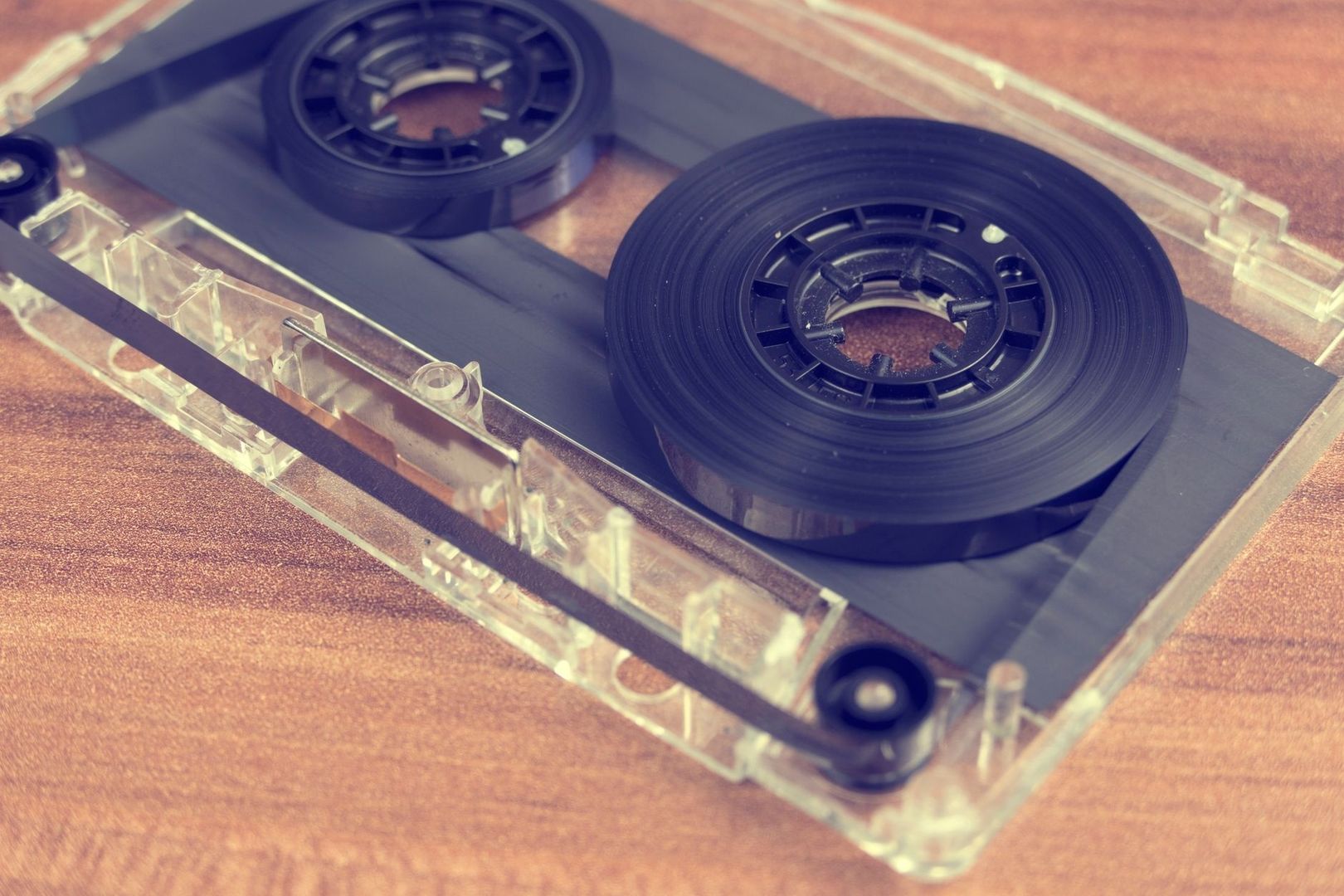
The Anatomy of Imperfection and Why Tape Resonates
Tape”s character begins with mechanics. Wow describes slower pitch variation caused by inconsistent transport speed, while flutter refers to faster, subtler fluctuations. In a cassette deck, the capstan, pinch roller, belt, motor, and tape itself all contribute to movement. A worn belt can produce an unstable pitch; a tired pinch roller can change the tape”s contact with the head; a portable recorder may exaggerate these shifts through cheap motors or loose tolerances. The result is not simply a pitch effect. It is a continuously changing relationship between rhythm, tone, and perceived space.
Tape hiss adds a bed of broadband noise, while head azimuth drift can soften or phase the high frequencies when the playback head is not perfectly aligned with the recorded tape. Cassette formulations, recording levels, bias settings, and tape speed further alter the result. Push the input too hard and the magnetic medium saturates, rounding transients and generating harmonics. Unlike a clean digital clip, which can produce abrupt and often unpleasant distortion, tape compression tends to make dense material feel more cohesive. Kick drums, sustained synths, field recordings, and layered samples begin to occupy a shared surface.
| Digital precision | Tape behavior |
|---|---|
| Stable pitch and timing | Wow, flutter, and gradual drift |
| Extended high-frequency response | Natural roll-off and softened transients |
| Predictable headroom and recall | Saturation, compression, and level-dependent coloration |
| Silence between sounds | Hiss, bleed, mechanical noise, and room interaction |
This contrast explains why tape can outperform a static “lo-fi” preset in a complex arrangement. A plugin may apply a fixed curve, noise layer, or modulation pattern, but a physical loop changes as it runs. The noise floor may become more apparent during quiet passages. A slightly unstable pitch can make a sustained chord feel as though it is breathing. Repeated overdubbing gradually reduces clarity and increases density, producing a sound that evolves through use rather than merely being selected from a menu. For producers, that changing behavior is often the real attraction.
Genre Shifts Across Ambient, Lo-Fi, and Modern Film Scoring
Lo-fi hip-hop turned cassette wobble into an emotional anchor. Tape hiss, detuned keys, vinyl crackle, swung drums, and restrained low end are not accidental defects in this context. They establish intimacy and memory, giving a beat the feel of a discovered artifact rather than a perfectly rendered file. The broader lo-fi tradition grew from affordable home recording, DIY distribution, indie music, and punk practice, where limitations often served expression. Contemporary producers can use that same logic without copying an old aesthetic wholesale.
Ambient artists and film composers apply tape differently. A four-track recorder can turn a simple pad into an unstable, slowly shifting bed for suspense, grief, dream sequences, or psychological unease. Print a chord progression, play it back at a different speed, record another layer, and repeat the process. Each pass changes the frequency balance and timing relationship. The final texture may contain enough movement to sustain tension beneath a scene without demanding attention as a conventional melody would.
- Use cassette wobble to make sustained notes feel vulnerable or human.
- Record multiple generations when a scene needs distance, memory, or decay.
- Combine degraded stems with clean samples so the contrast becomes part of the arrangement.
- Automate speed or pitch changes during transitions rather than applying instability uniformly.
- Keep some mechanical noise when it supports atmosphere, but edit distractions with intent.
Hybrid tools show how far this approach has travelled. BlankFor.ms Tape Synths from Spitfire Audio translates degraded tape machines, analog synthesis, granular processing, and experimental effects into a modern instrument. Its library includes more than 150 tape and granular layers across core presets, covering pads, keys, arpeggios, warped atmospheres, and lo-fi textures. Such a tool is not a replacement for hardware. It is a bridge between repeatable production and unstable source material, particularly useful when a composer needs to recall a cue or deliver stems under a tight schedule. The strongest workflows often pair a tactile cassette recording with a precise library such as BlankFor.ms Tape Synths, allowing clean arrangement decisions and damaged emotional detail to coexist.
Building Physical Tape Loops Step by Step
A useful tape loop begins with a practical decision about time. A short loop can lock closely to a rhythmic pattern, while a longer loop creates gradual shifts that resist obvious repetition. At a given tape speed, loop duration depends on the length of tape travelling past the head. Measure the tape path, calculate the required duration, and leave enough slack for a clean splice. Exact BPM synchronization is possible, but freeform timing often produces more compelling results because the loop slowly moves against the grid.
Choose a cassette shell with a stable housing and inspect the pressure pad, rollers, and hubs before committing valuable material. Older tape may be brittle, stretched, or shedding oxide. A four-track cassette can offer more direct control, but standard cassette mechanisms and micro-cassette recorders each contribute different speed, noise, and handling characteristics. The goal is not to find a universally “best” machine. The goal is to select a transport whose limitations support the intended texture.
- Mark the desired start and end points with a soft pencil or non-destructive marker.
- Cut the tape cleanly with a razor blade using a splicing block or another secure guide.
- Align the two ends without overlap and join them with narrow precision splicing tape.
- Check the splice by turning the hubs slowly before placing the loop under transport tension.
- Run the loop at low level, listen for clicks, scraping, or a rising splice, and rebuild it if necessary.
Splicing is a small act of engineering. A crooked cut creates a timing discontinuity or audible click, while excess adhesive can contaminate guides and heads. Pressure-sensitive adhesive works because it bonds quickly without heat or solvent, but adhesive choice matters, especially when loops are handled repeatedly. The wider industrial market for pressure-sensitive tapes is growing across packaging, medical, automotive, and electronics applications, as described in adhesive market research. Audio splicing requires a purpose-made, narrow tape rather than a generic household substitute.
Once the loop is assembled, route it carefully across external rollers, a pencil hub, or a modified cassette mechanism. External loops can extend cycle length beyond the cassette shell, but they expose the tape to dust, tangles, and uneven tension. A pencil or custom hub can provide a fast experimental setup, while a micro-cassette mechanism may create tighter, more visibly unstable cycles. Keep fingers clear of moving parts, avoid excessive tension, and archive any successful pass immediately into the DAW. Physical loops cannot be undone, and that irreversibility is both their risk and their compositional value.
Tactile Production Habits for the Software-Fatigued Musician
The most important shift is psychological. Printing audio destructively forces commitment. Once a vocal texture, drum bus, or synth passage has passed through a cassette deck, the producer must respond to what exists rather than endlessly refining an abstract possibility. This narrows the decision space and can restore momentum. A part that felt generic in software may become essential after one imperfect pass, while an overworked arrangement may reveal that its strongest version was the first one recorded.
Vintage Portastudios should also be treated as performance instruments, not passive playback units. Ride input levels, punch in at imperfect moments, move a speed control during a phrase, or bounce several layers while changing the monitoring balance. A four-track can become a small live mixer and effects system, where gestures are captured as sound. The renewed interest in cassettes is partly connected to this physical engagement, since the format demands effort and attention in ways that streaming does not. That effort can change how producers listen to their own material.
- Send a DAW stem through an interface output into a cassette deck, then record the return on a new track.
- Re-amp a software synth through a small amplifier, microphone, or portable recorder before editing it digitally.
- Keep both the clean and degraded versions, using the former for impact and the latter for atmosphere.
- Record several passes at different levels, speeds, or tape generations instead of searching for one perfect setting.
- Label each pass with machine, tape type, speed, and input level so useful accidents remain repeatable enough to revisit.
A disciplined hybrid chain might route a pad from the DAW to a Portastudio, return it through the interface, filter the hiss, and then place the result beneath a modern sample-library layer. Another approach is to print only transitional elements, such as risers, reverse tails, vocal fragments, or scene changes. This keeps the mix controllable while reserving physical instability for moments that need emotional emphasis. The best result is rarely total analog purity. It is a deliberate collision between digital recall and mechanical friction.
Bring Tactile Friction Back into Your Daily Mixes
Tape loops matter because they turn limitation into information. Wow and flutter can make a sustained tone feel alive. Hiss can establish a room around silence. Saturation can make layered sounds belong together, while generational loss can turn a clean source into something that feels remembered rather than merely recorded. These qualities are not automatically beautiful, and careless degradation can still produce mud, fatigue, or distracting noise. The creative advantage comes from choosing where imperfection enters and what dramatic function it serves.
Start with a thrift-store cassette deck, a modest four-track, a box of blank tapes, and a setup that makes experimentation easy. Print a loop before the next session becomes another exercise in microscopic editing. Let one take run too long. Change the speed while a chord sustains. Build a return chain that combines tape with modern EQ, compression, granular processing, or a precise sample library. In an overly digitized production landscape, listeners do not need technical damage for its own sake. They respond to evidence of movement, touch, and risk. When a mix carries the audible trace of a physical process, the connection can reach deeper than precision alone.